Commonwealth War Graves in Iraq
6 Squadron RAF, WW1 Aviation and My Books
Search Results
162 results found with an empty search
- 6 Squadron Photo Album Cover 1916
Here is a photograph of part of the front page of an album of WW1 photographs donated to Bungay Museum by the descendants of a local photgrapher, Alan Verso Clark, who served as a photographer with 6 Squadron during WW1.
- WW1 Aircraft Wireless Notes Found
Unearthed this week in my mother's loft are some hitherto unseen technical notes my grandfather wrote on the Type W Aircraft Transmitter that was used during WW1. I will add a photo here but will eventually create a sub menu on this website and transcribe my grandfather's notes for anyone who is interested in the early days of military airborne wireless installations.
- Flight Commander Streamers
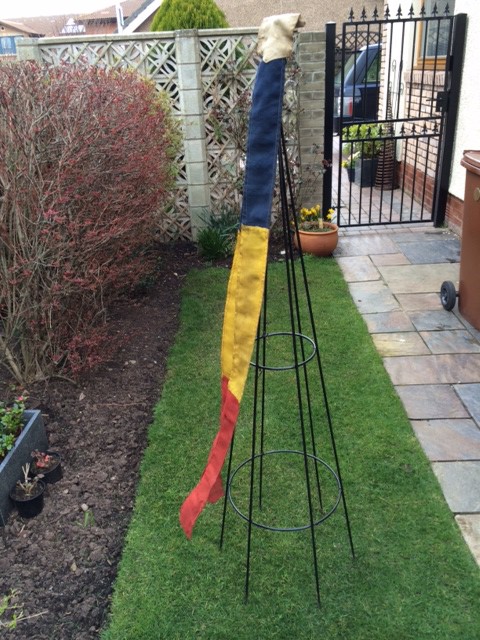
To coincide with 6 Squadron's official 100th anniversary celebrations in April, I have donated the flight commander streamers that my grandfather brought back from Belgium in 1918. They are already in the safe hands of George Robertson (see photo) and will shortly be taken to the squadron's home at Leuchars (just across the water from where George lives). Mike Baulkwill, the present OC 6 Squadron, has promised me the streamers will take to the air in a Typhoon during the 100th anniversary celebrations of 6 Squadron Royal Air Force.
- Poperinge City Archives
I sent a copy of my latest book, 'Over the Western Front' to Wouter Moyaert, the archivist at Poperinge Council and he kindly posted the following on the Poperinge City Archive Facebook page. As the book is set in the towns of Abele (Abeele) and Poperinge (Poperinghe), I thought it might make interesting research material for anyone who would like to know how the men of the Royal Air Force squadrons stationed around Ypres and Poperinge during the WW1 years interacted with the local civilian population. In the words of the archivist, " Post uit Australië! Auteur Steve Buster Johnson schreef op basis van het dagboek van zijn grootvader dit boek over de Eerste Wereldoorlog. Poperinge en Abele komen er uitgebreid in aan bod ."
- 6 Squadron use of Clock Code
During WW1, RAF squadrons which supported the allied artillery adopted a clock code system to report aiming corrections to the gunnery officer on the ground. Aerial photographs, at a height of between four and five thousand feet, were taken the day prior to the mission, with a clock code superimposed on each photograph, in alignment with the points of the compass. Though the complete clock code employed concentric circles set at Y (0 to 10 yards), Z (11 to 25 yards), A (26 to 50 yards), B (51 to 100 yards), C (101 to 200 yards), D (201 to 300 yards), E (301 to 400 yards) and F (401 to 500 yards), in practice 6 Squadron printed only the A, B and C rings, though fine corrections were interpreted when necessary for the Y and Z rings. Anything outside the accepted range was regarded as a 'washout' and the letter 'W' was transmitted so that the gunnery officer could re-align the gun used in ranging on to the target. I have attached two examples of 6 Squadron 'shoots', both in early July 1917, just after the attack at Messine, with the lower photograph at Zandvoorde showing the accuracy achieved by the artillery shells (see red marks) and the upper photograph at Hollebeke showing that two targets were attacked at approximately the same location.
- FlyBoys Exhibition at Lijssenthoek, Belgium
The 'Flyboys' exhibition opened in the Visitor Centre at the Lijssenthoek Military Cemetery on the 1st July and will be open daily until the 15th November. The exhibition tells the story of the Royal Air Force airmen who died during WW1 and were buried at Lijssenthoek and features some of my work, including extracts from my latest book, 'Over the Western Front'. Sixty-nine of the ninety-four airmen graves are for men who were stationed at Abeele, with thirty-one of this number serving with 6 Squadron at the time of their death. If you are planning to visit Ypres or Poperinge this year, I recommend a side trip to the Lijssenthoek Cemetery and Visitor Centre. The care in which the Belgian volunteers tend the 11,000 WW1 graves is quite remarkable and you can really appreciate the enormity of the sacrifice made by so many servicemen during that dreadful time.
- Burial at Hinaidi (Ma'Asker Al Raschid) RAF Cemetery 1925
Peter Burlton of the Habbaniya RAF Association sent me a photograph of a burial ceremony carried out in 1925 at the Hinaidi RAF Peace Cemetery. The grave and headstone of LAC John Bliss from the No 6 Armoured Car Company is marked with two crosses (location Plot 3 Row H Grave 7) and from the location and number of men attending the burial ceremony, the grave (Plot 3 Row I Grave 14) is most likely that of Squadron Leader Jasper Cruikshank, OBE, Officer Commanding No 6 Armoured Car Company (RAF), who died of Typhoid at Hinaidi on the 20th February 1925
- Lake Kynnumboon
And now for something completely different. After months of devastating bushfires up and down the East Coast of Australia, Nature changed course and decided to release half the annual rainfall in two short days over selected areas across that region. Up on the northern border of NSW, Lake Kynnumboon was formed literally overnight, with many roads submerged. Then, as quickly as it came, the sun came out and the lake disappeared.
- Another Hinaidi Cemetery Photo
Peter Reichelt recently contacted me regarding a photograph he found in his father's collection - a snapshot taken in the nineteen-twenties, while the Hinaidi RAF Peace Cemetery (later renamed the Ma'Asker Al Raschid RAF Cemetery) was still part of the Hinaidi Cantonment, under the protection of the Royal Air Force. The men standing behind Willian Bartlett's headstone are dressed in the uniform of the RAF Armoured Car Companies. On the right in the photograph is the headstone of Flying Officer Ellis Reid of 1 Squadron RAF and the headstone on the left is for Alexander Noble, a private in the Bedfordshire and Hertfordshire Regiment. Peter has kindly permitted me to include the photograph in the Hinaidi section of my website.
- Remembrance Day 2022 at Ma'Asker RAF Cemetery
After the annual Remembrance Day ceremony carried out by British Embassy staff at the Baghdad North Gate Cemetery on the morning of Friday 11th November 2022, wreaths were laid in the afternoon at the Ma'Asker RAF Cemetery (formerly the Hinaidi RAF Peace Cemetery) in a small gathering to mark the first anniversary of the cemetery's re-dedication.
- Remembrance Day at Hinaidi (Ma' Asker Al Raschid) RAF Cemetery
With the invaluable assistance of the British Embassy in Baghdad, I am pleased to announce that the first phase of the restoration project is about to commence, comprising the erection of a boundary wall and the setting up of a basic maintenance plan. The first step in the process of bringing the cemetery back into the fold was a pivotal and significant event that took place at Hinaidi yesterday (11th November 2020) when the British Embassy’s Defence Attaché in Baghdad, Brigadier Adam McRae, laid a wreath at the foot of the grave of Brigadier-General Sir Gilbert Falkingham Clayton KCMG KBE CB, British High Commissioner to Iraq at the time of his death in 1929. This was probably the first time in more than half a century that Remembrance Day has been commemorated at Hinaidi and hopefully it won’t be the last. Shown below is a photograph that Brigadier McCrae took to mark the occasion. Though the headstone is missing its upper section, it can be seen that some remedial work has already been carried out re the state of the cemetery. I will add photographs in this News section as and when they become available.
- Habbaniya War Cemetery - Plot 6
My website is the only place you will find individual headstone photos of each of the 290 burials at the Habbaniya War Cemetery in Iraq. For this reason I am posting photos in this News/Blog section of each of the plots. This is a wide-angle view of Plot 6 as well as a diagram of the cemetery which shows the location of each Plot. The view is from the north-east corner of Plot 6 looking towards the south-west corner. For more information and to view individual grave photographs, refer to the Habbaniya section on this website. Plot 6 at the RAF Habbaniya War Cemetery. The headstone in the immediate foreground 6. G. 10 marks the grave of LAC G G Etchells of the Royal Air Force Plan of the RAF Habbaniya WAr Cemetery, Iraq