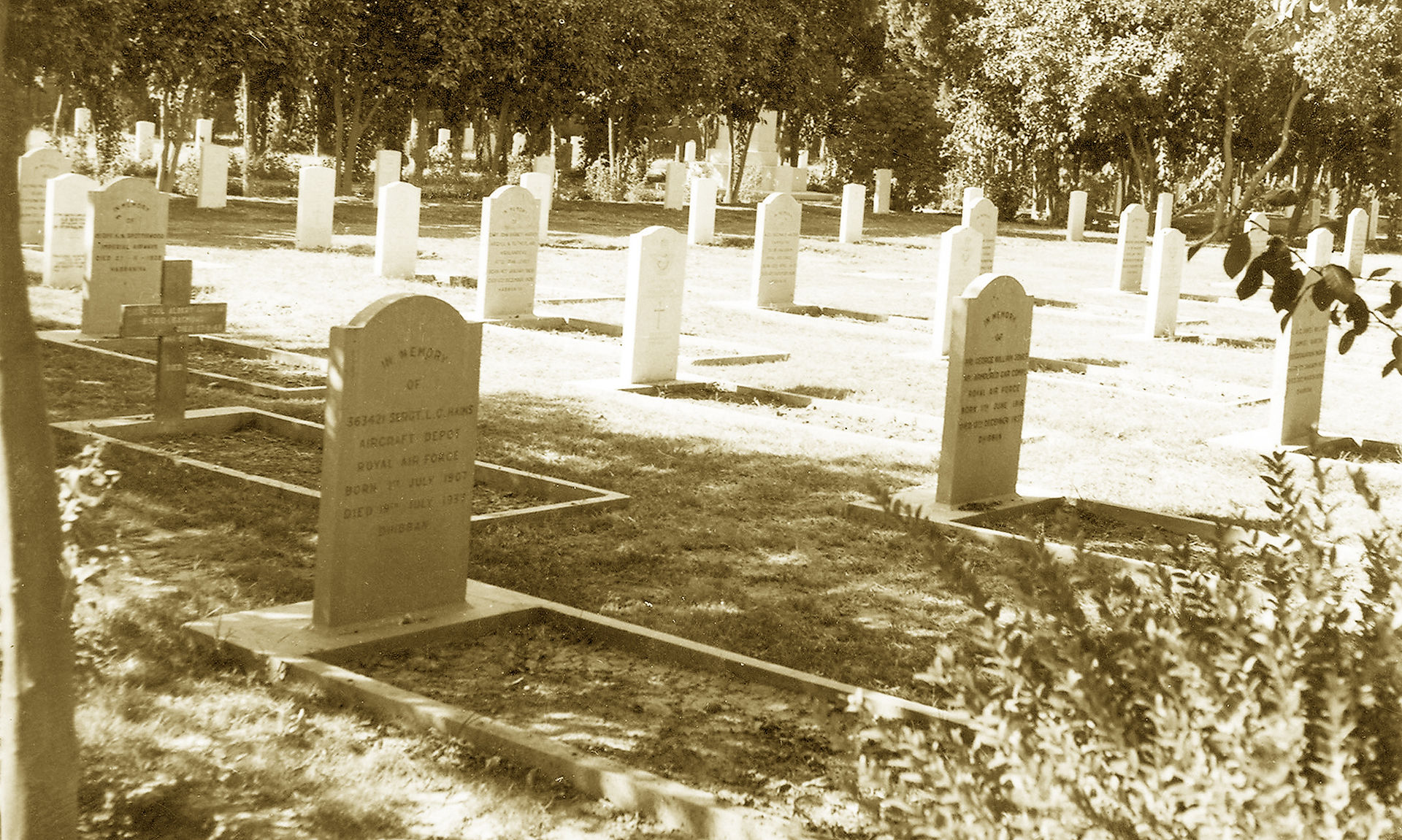

Siege of Habbaniya - Death of Flt Lt Sir Roderic MacRobert 94 Sqn
Whilst researching a Royal Air Force pilot who was killed in Iraq in May 1941, I came across a photograph in the RAF Habbaniya Association photographic archives that caught my eye. What was once RAF Habbaniya and the Habbaniya War Cemetery were located fifty-five miles to the west of Baghdad. The photograph in question was a close-up of a memorial board that used to be mounted in the Station Dining Hall at RAF Habbaniya, honouring the men of the Kings Own Royal Regiment (KORR) and the Royal Air Force who were killed in action during the Anglo-Iraqi war of May 1941 - also called the 'Siege of Habbaniya'. This was a period of twenty-nine desperate days during which the RAF Habbaniya cantonment came under siege, with only one resident RAF squadron to protect the base; the unarmed and ill-equipped No 4 Flying Training School.
Looking through the names of the Royal Air Force deaths on the board, I found the subject of my research, Flying Officer Gerald Herrtage. From the official records kept at RAF Habbaniya he was listed as serving with the No 4 FTS when in reality he was serving with 94 Squadron, whose base was RAF Ismailia in Egypt, 650 miles WSW of Habbaniya. F/O Herrtage was one of the pilots in a detachment of Gloucester Gladiators from 94 Squadron that had been sent to bolster the forces at RAF Habbaniya, along with a flight of Blenheim light bombers from 203 Squadron. Looking closer, I recognized another name on the board, though it was not one I would have associated with RAF Habbaniya, as I was well aware that the pilot in question had been killed near Mosul, 240 miles north of Habbaniya, and his body buried at the Mosul War Cemetery. The name (though one of the initials was incorrect) was unmistakable: ‘F/Lt. Sir R.A.T. MacROBERT’.

Many people know the history of the MacRobert Trust and the 6 Squadron Typhoon ‘The MacRobert Fighter’ that currently bears the name of the second of three MacRobert sons, ‘Sir Roderic’. Though much has been written about the Anglo-Iraqi War (the ‘Siege of Habbaniya’) that took place in the month of May 1941, little is known of 94 Squadron’s involvement in the fight to save RAF Habbaniya or the pivotal role that Sir Roderic MacRobert played in bringing the siege to an end. This article is a detailed account of Sir Roderic’s service career, taken from numerous documents held in the National Archives, including the Operations Record Books (ORBs) for 6 Squadron and 94 Squadron.
At 0640 on 22 May 1941, six days after the loss of his friend, Flt Lt Sir Roderic in Hurricane N2498 left on a mission with F/O Edward A Metcalfe in Hurricane V7543 to attack the German air base at Mosul. They arrived over Mosul after a little more than an hour with the pre-arranged plan for each of them to carry out two short strafing runs on the airfield’s infrastructure and any aircraft they could see on the ground before making a hasty retreat back to RAF Habbaniya. Sir Roderic went first and completed his first strafing run, setting fire to two petrol lorries and hitting several of the parked aircraft. As he climbed away and circled around for his second run, he could see F/O Metcalfe’s Hurricane in a steep dive, the apparent target being a number of enemy aircraft that were parked close together along the edge of the runway. Men were running towards the aircraft from the main buildings, obviously in an attempt to save them and hopefully engage with the Hurricanes before they disappeared. By the time Sir Roderic had committed to his second run, a huge pall of thick black smoke hung over the remains of the lorries and he chose a line of approach that would concentrate his firepower on the already damaged aircraft. With his ammunition exhausted, he climbed away and headed south, not waiting for his wingman to complete his second run or looking to see if any enemy aircraft had managed to take off in pursuit. Time was of the essence.
Sir Roderic was never seen again alive. According to F/O Metcalfe when he arrived back at RAF Habbaniya after 2 ½ hours in the air, he assumed that Sir Roderic’s defenceless Hurricane had been shot down. He added that several Heinkel 111 and Messerschmidt 110 bombers had been destroyed in the attack but that there would have been others that were capable of giving chase. His assumption proved to be the case as Sir Roderic’s crashed Hurricane was eventually located and his body returned to Mosul for burial. It is ironic that had Sir Roderic been shot down closer to RAF Habbaniya he would have been buried there and still be honoured with a headstone at the restored Habbaniya War Cemetery rather than be buried at the all but obliterated Mosul War Cemetery. The measure of success of the dangerous mission to Mosul was the fact that RAF Habbaniya was not bombed again.
Sir Roderic MacRobert and Gerald Herrtage were the only 94 Squadron fatalities during the Anglo-Iraqi war. By the end of May 1941, the operations at RAF Habbaniya had returned to normal with Britain and its Allies having quelled the revolt and installed a pro-British government. With no operations out of RAF Habbaniya after the 31st May, the detached flight from 94 Squadron was moved to RAF Almiriya Egypt and used in the defence of Alexandria.
P.S. In time the link between Sir Roderic and 6 Squadron would turn full circle. After the ‘Siege of Habbaniya’ was lifted, the Hurricane flown by Sir Roderic’s wingman on that fateful day was not kept by 94 Squadron; instead it was sent to 6 Squadron based at RAF Qasaba in Egypt. Two months after Sir Roderic’s death, his younger brother Sir Iain (the sole survivor of the three MacRobert brothers) went missing in action on 30 June 1941 on a ‘search and rescue’ mission whilst piloting a 608 Squadron Blenheim and his body was never found. When Lady MacRobert set up the MacRobert Trust and donated money to sponsor RAF aircraft, the first ‘Sir Roderic’ MacRobert Fighter was allocated in 1942 to 94 Squadron in Egypt. This aircraft was flown by none other than Flt Lt Arnold Edgar ‘Blondie’ Walker DFC (& Bar), who a year later on 13 April 1943 left 94 Squadron and joined 6 Squadron in Italy (refer Tin-opener No 133 for full story of 6 Squadron’s WW2 operations in Italy). Since 2017, 6 Squadron has flown a ‘Sir Roderic’ marked aircraft.
On 07 May 1938, Sir Roderic Alan Workman MacRobert was granted a short service commission as Pilot Officer (acting) whilst at the RAF No 4 FTS. At that time the flying school was part of RAF Abu Sueir in Egypt but it moved the following year on 01 September 1939 to RAF Habbaniya, two days before the outbreak of WW2. After completing his training, P/O Sir Roderic was posted to 6 Squadron at RAF Ramleh, located in Central District Palestine (now Israel), arriving by train on 03 January 1939, the day his rank was gazettted as being ‘on probation’. At that time, 6 Squadron was operating the Hawker Hardy, a two-seat light bomber biplane and P/O Sir Roderic’s role as a pilot was to carry out ‘air cordon’ and reconnaissance sorties over Palestine and Trans-Jordan. One of the first squadron events he attended was the official dinner on the evening of 31 January when 6 Squadron celebrated its Silver Jubilee.
An example of one of the sorties P/O Sir Roderic carried out was on 23 May during a solo evening ‘air cordon’ sortie when he spotted an armed gang which he deemed presented a threat. He attacked with ground assistance from men of the 2nd Battalion, Queen’s Own Royal West Kent Regiment. As a result, eleven of the gang members were killed with the loss of one British Army officer and three men injured. A month later Sir Roderic was confirmed in his rank of Pilot Officer.
On 19 June, P/O Sir Roderic received orders to proceed to HQ RAF Palestine & Trans-Jordan where he was to be the personal assistant to the AOC, Air Vice Marshall A. T. [later nicknamed ‘Bomber’] Harris OBE AFC. He remained in this capacity at the RAF HQ until the end of July when the AOC relinquished his command and returned to England to take command of the No 5 Bomber Group. Before returning to active duty with 6 Squadron, P/O Sir Roderic flew to England on an Imperial Airways Short S23 Empire flying boat with the intention of taking two months leave. However, with the risk of WW2 mounting he was ordered to return to 6 Squadron after only a month, arriving on 01 September where he was allocated to ‘B’ Flight and given charge of the photographic section.
Whilst Sir Roderic was on leave, 6 Squadron increased its capability on 24 August 1939 by re-equipping ‘A’ Flight with the Gloucester Gauntlet, a single seat biplane fighter that would become the last open-cockpit aircraft used by the RAF. By the end of August, two Westland Lysander Mk I reconnaissance machines had also been added to the squadron’s complement of aircraft as well as an upgrade to every Hawker Hardy by replacing the Rolls Royce Kestrel IB engine with the more powerful Kestrel X.
On the introduction of military censorship at midnight on 05 September 1939, P/O Sir Roderic was appointed one of two censor officers at 6 Squadron. From 6 Squadron’s Operations Record Book of the time, he continued to fly the Hawker Hardy on sorties for the rest of 1939, many of them medium altitude reconnaissance.
On 05 January 1940, P/O Sir Roderic was officially attached to Station Headquarters in Ismaila, pending embarkation to Aden. By the end of January, 6 Squadron resumed a normal training program as both operational commitments and the likelihood of calls for assistance from the land forces in Palestine were reducing. As of 01 February 1940, No 6 (Bomber) Squadron officially became an ‘Army Cooperation’ squadron and by early March the last of the Hawker Hardy machines was handed over to the Southern Rhodesian Air Force, with 6 Squadron re-equipped for its new role with thirteen Westland Lysanders.
After a year at Air Headquarters (Aden), located at Steamer Point, F/O Sir Roderic (his promotion gazetted on 03 September 1940) resumed flying duties when he was posted to 94 Squadron on 08 January 1941. At that time 94 Squadron was primarily based at Sheikh Othman, on the mainland of Aden, twelve miles north of the AHQ which was located on the peninsula, though individual flights were regularly rotated to ‘Little Aden’ on the western peninsula. 94 Squadron’s sole aircraft type on charge was the Mk II Gloucester Gladiator. F/O Sir Roderic assumed command of ‘B’ Flight and the following two months were spent mostly on exercises and standing patrols over and around Aden harbour, on some occasions involving eight aircraft in staggered patrols.
On 20 March, Sir Roderic was promoted to Acting Flight Lieutenant and two weeks later on 05 April 94 Squadron departed Aden, travelling by ship to Port Suez where the squadron, still equipped with Mk II Gladiators, was divided into two sections. The men of the first section entrained to RAF El Amiriya (Alexandria) and the second section went by road transport to RAF Ismailia, located at the southern end of the Suez Canal. On 16 April Flt Lt Sir Roderic and three other pilots flew to RAF Habbaniya on temporary duty, before returning to the main force at RAF Ismailia on 24 April, by which time the first of the Hurricane Mk I Hurricanes had arrived; a type that would replace all of the ageing Gladiators over the next two months.
On 7 May 1941, the day before Sir Roderic’s 26th birthday, OC 94 Squadron Wg Cdr W T F ‘Freddie’ Wightman, led a detachment of five Gladiators to RAF Habbaniya, including flight commander Flt Lt Sir Roderic MacRobert and his wingman F/O Gerald D F Herrtage. The role of the detached flight was to carry out standing patrols over Habbaniya as well as provide escort to bombers attacking Rashid Ali and the rebel forces in the area between Baghdad and Basra, thereby taking pressure off RAF Habbaniya which had already been under siege for almost a week. For nine days no enemy aircraft were sighted. On 15 May F/O Edward A Metcalfe arrived at RAF Habbaniya to bolster the numbers of 94 Squadron pilots. He was on attachment from the No 70 OTU (Operational Training Unit) at RAF Ismailia and unbeknown to him at the time he would in less than a week embark on a hazardous mission with Sir Roderic.
At 0315 on 16 May 1941, a single Blenheim Mk IVF of 203 Squadron flew 240 miles due north of RAF Habbaniya to attack the recently established German Air Base at Mosul. Being a modified ‘fighter’ version of the ageing Blenheim light bomber, the aircraft was armed with four forward-facing Browning .303 machine guns instead of carrying bombs. With only twenty seconds of continuous fire from the machine guns, damage to the airfield and the aircraft on the ground was more psychological than effective and the Blenheim had an uneventful flight back to base. The German Air Force immediately launched a counter-attack comprising three Heinkel 111 bombers which reached RAF Habbaniya that same morning at 0935, causing more damage to the base than all of the previous enemy bombing raids put together. 94 Squadron had been carrying out a standing patrol over Habbaniya since 0435 that morning with six of its Gladiators (in rotation) and it was F/O Gerald Herrtage who happened to be in the air to greet the Heinkels.
With no time to wait for backup, F/O Herrtage attacked the enemy bombers and succeeded in disabling one of them before he was caught in cross-fire which ruptured his fuel tank. Though he managed to bail out successfully, he was injured upon landing as his parachute was partially tangled when he exited his Gladiator. An ambulance from RAF Habbaniya raced to his aid and picked him up but sadly he was killed when the ambulance was bombed by one of the two remaining Heinkels. Within minutes of the initial engagement, OC 94 Squadron, Wg Cdr Wightman, Flt Lt Sir Roderic and Sgt L E Smith took off in their Gladiators in pursuit of the enemy raiders, but without success.
The following day, 17 May, the 94 Squadron detachment at RAF Habbaniya received an initial batch of four Hurricane Mk I fighters, a type that would eventually replace the ageing Gladiators. Before they could be put into action, however, two of the Gladiators left on an offensive reconnaissance to Baghdad and shot down two German ME110 (BF110) fighter-bombers as they were taking off from Raschid (formerly RAF Hinaidi prior to handover of the airfield to the Iraqis before WW2 in January 1936).
No doubt Wg Cdr Wightman was keen to avenge the loss of one of his own, especially a death clearly in violation of the Geneva Conventions, but the next few days proved too busy for 94 Squadron for this to take place. As an example, on 20 May, nine aircraft (four Gladiators and five Hurricanes) carried out a total of 26 sorties, with several successful engagements against aircraft and ground positions. On the same day, Flt Lt Sir Roderic, who had only flown a Hurricane twice in action, along with his new wingman F/O Edward A Metcalfe, who had already flown four sorties in a Hurricane, spent two hours together in Hurricanes on a reconnaissance around Baghdad.
An opportunity to retaliate against the German air base at Mosul presented itself on 21 May when (at the instigation of Wg Cdr Wightman? - we will never know) two long range Hurricane Mk Is arrived from RAF Ismailia with two replacement pilots for the 94 Squadron detachment flight. Both Hurricanes were equipped with fixed long range fuel tanks and armed with eight .303 Browning machine guns. Not only would they be capable of a return flight to Mosul, unlike the standard Mk I Hurricane, they could each deliver 2,800 rounds of concentrated firepower (the guns being in a single group on that type) over about fifteen seconds, sufficient to cause significant damage to any ground target.
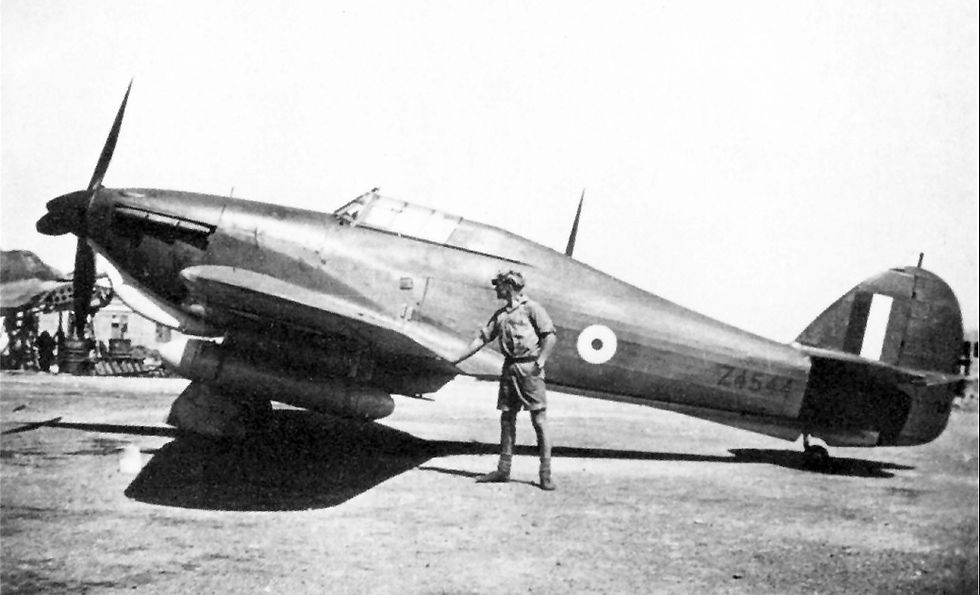

At 0640 on 22 May 1941, six days after the loss of his friend, Flt Lt Sir Roderic in Hurricane N2498 left on a mission with F/O Edward A Metcalfe in Hurricane V7543 to attack the German air base at Mosul. They arrived over Mosul after a little more than an hour with the pre-arranged plan for each of them to carry out two short strafing runs on the airfield’s infrastructure and any aircraft they could see on the ground before making a hasty retreat back to RAF Habbaniya. Sir Roderic went first and completed his first strafing run, setting fire to two petrol lorries and hitting several of the parked aircraft. As he climbed away and circled around for his second run, he could see F/O Metcalfe’s Hurricane in a steep dive, the apparent target being a number of enemy aircraft that were parked close together along the edge of the runway. Men were running towards the aircraft from the main buildings, obviously in an attempt to save them and hopefully engage with the Hurricanes before they disappeared. By the time Sir Roderic had committed to his second run, a huge pall of thick black smoke hung over the remains of the lorries and he chose a line of approach that would concentrate his firepower on the already damaged aircraft. With his ammunition exhausted, he climbed away and headed south, not waiting for his wingman to complete his second run or looking to see if any enemy aircraft had managed to take off in pursuit. Time was of the essence.
Sir Roderic was never seen again alive. According to F/O Metcalfe when he arrived back at RAF Habbaniya after 2 ½ hours in the air, he assumed that Sir Roderic’s defenceless Hurricane had been shot down. He added that several Heinkel 111 and Messerschmidt 110 bombers had been destroyed in the attack but that there would have been others that were capable of giving chase. His assumption proved to be the case as Sir Roderic’s crashed Hurricane was eventually located and his body returned to Mosul for burial. It is ironic that had Sir Roderic been shot down closer to RAF Habbaniya he would have been buried there and still be honoured with a headstone at the restored Habbaniya War Cemetery rather than be buried at the all but obliterated Mosul War Cemetery. The measure of success of the dangerous mission to Mosul was the fact that RAF Habbaniya was not bombed again.
Sir Roderic MacRobert and Gerald Herrtage were the only 94 Squadron fatalities during the Anglo-Iraqi war. By the end of May 1941, the operations at RAF Habbaniya had returned to normal with Britain and its Allies having quelled the revolt and installed a pro-British government. With no operations out of RAF Habbaniya after the 31st May, the detached flight from 94 Squadron was moved to RAF Almiriya Egypt and used in the defence of Alexandria.
P.S. In time the link between Sir Roderic and 6 Squadron would turn full circle. After the ‘Siege of Habbaniya’ was lifted, the Hurricane flown by Sir Roderic’s wingman on that fateful day was not kept by 94 Squadron; instead it was sent to 6 Squadron based at RAF Qasaba in Egypt. Two months after Sir Roderic’s death, his younger brother Sir Iain (the sole survivor of the three MacRobert brothers) went missing in action on 30 June 1941 on a ‘search and rescue’ mission whilst piloting a 608 Squadron Blenheim and his body was never found. When Lady MacRobert set up the MacRobert Trust and donated money to sponsor RAF aircraft, the first ‘Sir Roderic’ MacRobert Fighter was allocated in 1942 to 94 Squadron in Egypt. This aircraft was flown by none other than Flt Lt Arnold Edgar ‘Blondie’ Walker DFC (& Bar), who a year later on 13 April 1943 left 94 Squadron and joined 6 Squadron in Italy. Since 2017, 6 Squadron has flown a ‘Sir Roderic’ marked aircraft.

Grave of Flt Lt Sir Roderic MacRobert 94 Sqn at Mosul War Cemetery, Iraq
